
Where Was God During the Holocaust?
If the Jewish people are truly God’s chosen nation, how could He allow the Holocaust—the greatest catastrophe in Jewish history—to happen? Doesn’t such a tragedy prove that there’s no special Divine providence over our people, that the world runs without moral reckoning?
The Holocaust confronts the believer with one of the most profound tests of faith. It raises what is perhaps the most difficult question in Jewish theology: How can we reconcile the Jewish belief that God is good, compassionate, and merciful—that He is our Father and our King—with the horrors, suffering, and torment endured by millions?
This is not a theoretical discussion. It is a question that must be approached with reverence and humility toward both the victims and the survivors. Some emerged with their faith intact; others lost it entirely. Who can judge people who lost everything they loved and witnessed scenes no human eye should ever see?
“I’m Not Willing to Believe in a God I Understand”
The question “Where is God?” is not confined to the Holocaust. In truth, it echoes in everyday life too. We ask it when a mother and child die in a car crash, when a father is taken by cancer, or when a baby is born with a crushing genetic defect. At its core, it’s always the same question: why do innocent people suffer?
This question is deeply embedded in Jewish thought. It appears in the Book of Iyov and in countless works of Jewish philosophy. Even Moshe, the greatest of prophets, could not fathom God’s ways. The Talmud relates that when Moshe asked God to explain His governance of the world, the answer was: “I will be gracious to whom I will be gracious, and I will show mercy to whom I will show mercy” (Shemot 33:19), whether or not it is earned or deserved.
On a foundational level, Judaism maintains that no matter how much we strive, we cannot fully comprehend God. As Kohelet says, “God is in heaven, and you are on earth” (Kohelet 5:1). Rabbi Menachem Mendel of Kotzk put it bluntly: “I’m not willing to believe in a God I understand.”
Throughout history, great figures of faith have asked God hard questions without renouncing their faith. Avraham, the first man to be called a believer, passed ten grueling tests, yet when God told him of Sodom’s impending destruction, he protested: “Shall the Judge of all the earth not do justice?” (Bereishit 18:25). Gideon, in the Book of Shoftim likewise questioned the angel who told him God was with Israel: “If the Lord is with us, why has all this happened to us?” (Shoftim 6:13).
Many righteous figures questioned why God runs the world the way He does, yet their faith never faltered. Even during the Holocaust, countless Jews wrestled with the same questions but continued to believe with deep conviction, recognizing that God’s Divine plan will always be beyond human understanding.
Faith in the Inferno
One remarkable example from the Holocaust is Rabbi Yekutiel Yehuda Halberstam, the Klausenburger Rebbe, who lost his wife and eleven children. In a concentration camp, fellow inmates recalled seeing him carry heavy loads during forced labor while murmuring to himself, “I deserve this,” accepting his suffering as atonement. The following episode occurred on the Rebbe’s first day at the camp:
As he stepped through the camp gates and saw three young men who had arrived with his transport, he immediately began speaking to them about strengthening their faith and accepting suffering with love. Then, with rising emotion, he asked them in Yiddish: “Do you believe that the Creator, blessed be He, is here with us?” Without hesitation, they cried out in unison: “We believe!” The Rebbe, his voice trembling with even greater intensity, called back: “Then remember this well and never forget: the Master of all worlds is here with us, and He will redeem us. I promise you that through faith, you too will be redeemed and walk out of here alive.”
The Rebbe refused to eat non-kosher food, even at the risk of starvation, telling God: “You have taken everything from me…shall I now eat forbidden food? I will not!” Miraculously, he survived, immigrated to Israel, rebuilt his life, and founded the Laniado Hospital in Netanya. He attributed his survival to one thing: “Even in the darkest times, I never harbored complaints against Heaven. I accepted every wave that struck me with love.”
The Difficult Answer
So where was God during the Holocaust? The answer, as painful as it is profound, is that He was there.
He was there in the camps, in the ghettos, in hiding places, and even in the gas chambers. “The whole earth is full of His glory” (Yeshayahu 6:3), whether or not we can understand it, accept it, or feel it. God’s presence is not contingent on human perception, nor does He conform to our comfort. We will never grasp the full measure of His love, nor always understand how it is expressed.
It is also important to note that for many survivors who lost their faith, the rupture did not only come from theological questions. The Holocaust erased their entire former world, their families, communities, and traditions. When they severed themselves from that world in order to survive emotionally, they often left behind their religious life as well.
And yet, countless survivors clung to faith even in the heart of the inferno. In some camps, even among the Sonderkommando—the Jews forced to work in the crematoria—prayer groups still met daily. For those of us who were not there, it is almost impossible to comprehend. But it stands as testimony that even in history’s darkest moment, there were many who continued to cling to their faith. There is nothing but Him.
The Torah’s Perspective
Though we will never understand God’s Divine calculations, the Torah does not hide the fact that suffering exists, nor does it present reward and punishment as random. It explicitly lays out blessings for those who follow God’s ways, and consequences for those who abandon them (see Vayikra 26 and Devarim 28).
Though we will never be able to fathom the atrocities and suffering of the Holocaust, it is hard not to detect the spiritual state of much of European Jewry before the Holocaust: widespread assimilation, rejection of tradition, and an eagerness to resemble the surrounding nations, especially German culture. Historian Prof. Bernard Wasserstein described the demographic and cultural collapse of prewar European Jewry, as evidenced by declining birthrates, rising intermarriage, loss of Jewish languages like Yiddish and Ladino, and a sharp drop in religious observance.
From the Torah’s point of view, our true destination is not this temporary world but the eternal World to Come. The soul is immortal; its journey here is to fulfill its mission so it can enjoy eternal good. Sometimes, suffering is seen as a way to redirect a soul that has strayed from its path.
Even though our ability to grasp Divine justice and mercy in this world is limited and we are unable to see their cause or purpose, in the World to Come, where truth is fully revealed, we will recognize that everything was done for the eternal good of the soul
May the memory of all who perished in the Holocaust be a blessing forever. “He will swallow up death forever, and the Lord God will wipe away tears from all faces, and remove the reproach of His people from all the earth—for the Lord has spoken” (Yeshayahu 25:8).
As Pesach 1944 approached in Bergen-Belsen, the Jews knew that not only would they be unable to hold a Seder, but they would also be forced to eat bread during the holiday simply to stay alive. In response, one of the prisoners, Rabbi Ludwig Willner, composed a special prayer to recite before eating chametz (leavened bread).
Our Father in Heaven, it is revealed and known before You that our true desire is to do Your will and celebrate Pesach by eating matzah and by refraining from chametz. Yet our hearts are pained, for bondage prevents us, and our lives are in danger. We are ready and prepared to fulfill Your commandment, ‘and you shall live by them, and not die by them.’ Therefore, we pray before You: give us life, sustain us, and redeem us soon, so that we may keep Your laws, do Your will, and serve You with a whole heart. Amen.
Rabbi Baruch Rabinowitz, the Rebbe of Munkacs, who managed to escape at the end of the Holocaust and later immigrated to Israel, recalled the darkest moments in his memoirs: “The Holy One, blessed be He, hid His face from us and removed His awareness of all that was happening to us. He did not follow at all (Heaven forbid) what the destroyers were doing to us, having been given license to destroy. This was something we could never come to terms with…”
And yet, he never lost his faith, even a moment. He continued: As for the future, we had no doubt. We were certain that God would reveal Himself as the Savior, the Redeemer of Israel. We were convinced that what was happening to us was not an isolated tragedy, but part of the covenant foretold [to Avraham] at the Covenant Between the Pieces, and that every exile is but a continuation of the original exile in Egypt.
Rabbi Kalonymus Kalman Shapira, the Rebbe of Piaseczno, lost his wife and children at the very outbreak of the war. Though broken in spirit, he continued to deliver words of strength and encouragement in the Warsaw Ghetto. He wrote down these sermons and hid them in milk cans beneath the ghetto’s soil. Rabbi Shapira perished in the Holocaust, but after the war the writings were discovered by chance under the ghetto’s ruins. They were later published as the book Eish Kodesh (Sacred Fire). Though the Rebbe’s words reflect the immense pain and suffering of the ghetto’s Jews, alongside the anguish shines a profound and uplifting faith, even in the darkest of hours.
Jean Améry, a French-Jewish intellectual and atheist, was deported to concentration camps during the Holocaust. In his book At the Mind’s Limits, he reflects on his struggle as a philosopher to grapple with the horrors, and his deep admiration for those of faith:
I must admit that I admired—and still admire—my religious fellow prisoners. Whether they were ‘spiritual’ people or not, in the most decisive moments their faith proved an invaluable source of strength. It gave them a firm foothold in a world that had been uprooted from its axis by the SS. Observant Jews, though starved year-round, would still fast on Yom Kippur. They endured more steadfastly, or else died with greater dignity, than their intellectual comrades who had no faith at all.
One of the most famous Holocaust survivors was Elie Wiesel, born in Romania and deported as a teenager with his father to Auschwitz. After the war, he published his searing memoir Night and went on to receive the Nobel Peace Prize. In his book, he describes a harrowing scene in the camp that shook his faith in Divine providence. Some interpreted his words as heresy, but years later he clarified: “I rebelled against God’s silence… I had questions and protests. But I never lost my faith in God.”
As Pesach 1944 approached in Bergen-Belsen, the Jews knew that not only would they be unable to hold a Seder, but they would also be forced to eat bread during the holiday simply to stay alive. In response, one of the prisoners, Rabbi Ludwig Willner, composed a special prayer to recite before eating chametz (leavened bread).
Our Father in Heaven, it is revealed and known before You that our true desire is to do Your will and celebrate Pesach by eating matzah and by refraining from chametz. Yet our hearts are pained, for bondage prevents us, and our lives are in danger. We are ready and prepared to fulfill Your commandment, ‘and you shall live by them, and not die by them.’ Therefore, we pray before You: give us life, sustain us, and redeem us soon, so that we may keep Your laws, do Your will, and serve You with a whole heart. Amen.
Rabbi Kalonymus Kalman Shapira, the Rebbe of Piaseczno, lost his wife and children at the very outbreak of the war. Though broken in spirit, he continued to deliver words of strength and encouragement in the Warsaw Ghetto. He wrote down these sermons and hid them in milk cans beneath the ghetto’s soil. Rabbi Shapira perished in the Holocaust, but after the war the writings were discovered by chance under the ghetto’s ruins. They were later published as the book Eish Kodesh (Sacred Fire). Though the Rebbe’s words reflect the immense pain and suffering of the ghetto’s Jews, alongside the anguish shines a profound and uplifting faith, even in the darkest of hours.
One of the most famous Holocaust survivors was Elie Wiesel, born in Romania and deported as a teenager with his father to Auschwitz. After the war, he published his searing memoir Night and went on to receive the Nobel Peace Prize. In his book, he describes a harrowing scene in the camp that shook his faith in Divine providence. Some interpreted his words as heresy, but years later he clarified: “I rebelled against God’s silence… I had questions and protests. But I never lost my faith in God.”
Rabbi Baruch Rabinowitz, the Rebbe of Munkacs, who managed to escape at the end of the Holocaust and later immigrated to Israel, recalled the darkest moments in his memoirs: “The Holy One, blessed be He, hid His face from us and removed His awareness of all that was happening to us. He did not follow at all (Heaven forbid) what the destroyers were doing to us, having been given license to destroy. This was something we could never come to terms with…”
And yet, he never lost his faith, even a moment. He continued: As for the future, we had no doubt. We were certain that God would reveal Himself as the Savior, the Redeemer of Israel. We were convinced that what was happening to us was not an isolated tragedy, but part of the covenant foretold [to Avraham] at the Covenant Between the Pieces, and that every exile is but a continuation of the original exile in Egypt.
Jean Améry, a French-Jewish intellectual and atheist, was deported to concentration camps during the Holocaust. In his book At the Mind’s Limits, he reflects on his struggle as a philosopher to grapple with the horrors, and his deep admiration for those of faith:
I must admit that I admired—and still admire—my religious fellow prisoners. Whether they were ‘spiritual’ people or not, in the most decisive moments their faith proved an invaluable source of strength. It gave them a firm foothold in a world that had been uprooted from its axis by the SS. Observant Jews, though starved year-round, would still fast on Yom Kippur. They endured more steadfastly, or else died with greater dignity, than their intellectual comrades who had no faith at all.
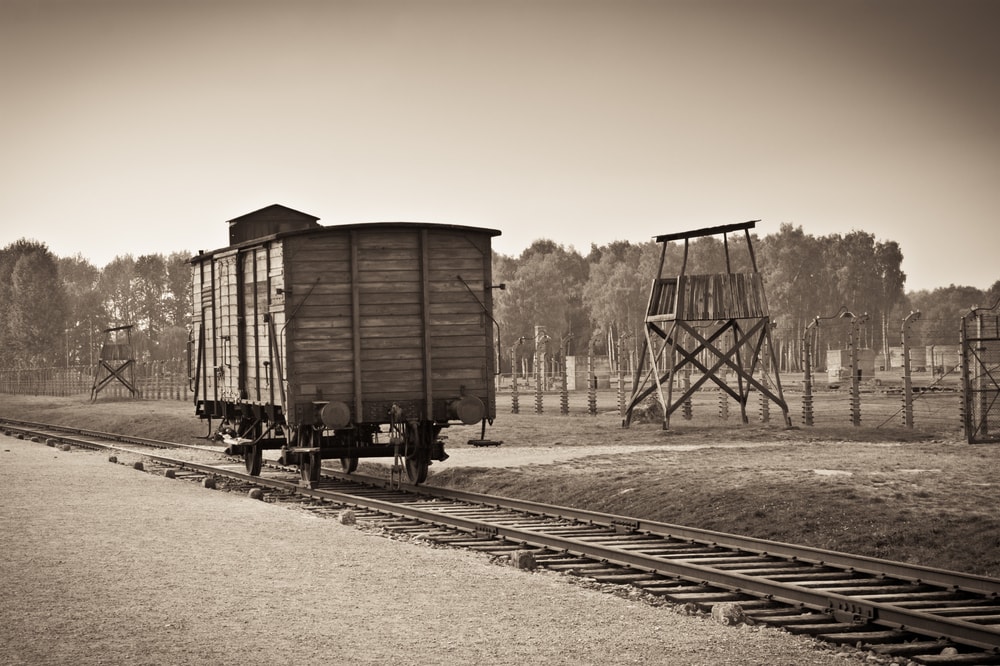
On a Shabbat, packed into a cattle car heading east, Rabbi Sinai Adler watched his father take out a piece of bread he had saved, recite Kiddush over it, and divide it into three portions. “That was our Shabbat meal,” Rabbi Adler recalled years later. “Even on the way to Auschwitz, my father did not forget to sanctify the day.”
When the train finally stopped, the doors opened. Adler remembers looking out into the night: “About 1500 feet away, I saw a tall chimney with flames shooting from it. The next morning we asked where we were. They said: ‘This place is called Auschwitz. You enter through the gate and you leave through the chimney.'”
Adler survived the selektion, though his parents did not. Left alone, his faith carried him through. He found strength in an unexpected friend: “One night, as I was ready to close my eyes from sheer exhaustion, the boy next to me said, ‘I have one request. We must keep learning Torah each night.’ He began to study aloud, with the tune of the yeshiva, as if we were back in the study hall. For a while, he forgot Auschwitz, he forgot the chimneys. All he knew was that as long as his eyes were open, he had to serve the Holy One.”
Even at the Pesach Seder in Auschwitz, Adler and the other boys recited the Haggadah from memory as they walked. “We said: ‘This is the bread of affliction our ancestors ate in Egypt.’ But we had nothing. Not even bread of affliction. We said: ‘We were slaves to Pharaoh in Egypt, and now we are free.’ How could we say that? We were worse than slaves, with no rights at all. Yet looking back, I realize it was true: no nation can make us slaves. They can torment us, but a Jew who is a servant of God will never be a servant to man.”
And so they ended with the words, “Next year in Jerusalem.” Rabbi Adler added quietly: “It was a prayer from the depths of our hearts. And indeed, the next year, God allowed me to be in Jerusalem.”
Decades later, in the middle of an interview, Rabbi Adler received a call from his son: he had just become a great-grandfather for the second time that very night. Smiling, he concluded, “We must always remember what we endured, so that we never stop thanking God for the miracle of being alive, despite all the enemies of Israel.”